11/06/2019

12. Wallis and Squaring of the Circle


The squaring of the circle, together with the problem of angle trisection and that of cube duplication, is a classical problem in Greek mathematics, whose purpose is to construct a square that has the same area as a given circle, with exclusive use of straightedge and compass.


In 1882, Ferdinand Lindemann, of the University of Munich, showed that pi is transcendent, thus forever drawing a line on the problem of squaring the circle; from the proof provided by Lindemann, it turns out that it is impossible to construct, only with straightedge and compass, a square of area equal to that of a given circle, a problem that has tormented entire generations of mathematicians since before Euclid. Lindemann showed that pi is not an algebraic number.
Any geometry problem that can be solved only with the ruler and the compass, when placed under its equivalent algebraic form, leads to one or more algebraic equations with integer rational coefficients that can be solved by successive extractions of square roots. Since π does not satisfy any of these equations, we cannot arrive at the quadrature of the circle with the instruments in question.
Note: with row and compass it is obviously possible to "construct" the positive integers as whole distances from the given origin. Every rational number is constructible, and this thanks to Thales' beautiful theorem on similar triangles; furthermore it can be shown that the square root of any constructible number is itself constructible.

A fractal is a geometric object that is repeated in its form in the same way on different scales, and by enlarging any part of it you get a figure similar to the original.

In the previous post we saw the Sierpinski carpet, a fractal obtained from a square, described by the Polish mathematician Wacław Sierpiński in 1916. At each step the squares that make up the figure are divided into 9 smaller squares and the central square is removed. In this way, for each step the area is reduced by 8/9, so the fractal dimension of the carpet is log 8 / log 3, equal to 1.892789 ...

Now let's see another object that "might" look similar to the previous one.
The sieve of Wallis is thus constructed:

it starts with a 2 x 2 square and is divided into 4 squares;
divide each new sub-panel by 9 and remove the central square (8/9);
each new sub-panel is divided by 25 and the central square (24/25) is removed;
each new sub-panel is divided by 49 and the central square (48/49) is removed;
each new sub-panel is divided by 81 and the central square (80/81) is removed
and so on.

Here's how it looks after a few steps:


I said "could" because the Wallis sieve is a fractal-like, at every step the rule changes and therefore self-similarity is not maintained. However, while in the case of the carpet the area (Lebesgue measure) is zero, for the sieve the area has a well-known value.
The initial value is by definition 4, then in the order it is multiplied by 8/9, 24/25, 48/49, 80/81, ..., (n2 - 1) / n2

This is the famous Wallis product:


which can also be rewritten in this way:


The wonder lies in the fact that the areas of the Wallis sieve and the Circle are the same.

Let's see 2 more views:


in the first figure we start with only 1 square and relate to the relative inscribed circle, while the same object is then decomposed and recomposed to better highlight the equivalence of circle and sieve.

With straightedge and compass you can therefore build a "square" equivalent to the circle, just have patience and the necessary time ... if it is not exactly a square, it somehow looks like it.

Another way could be the following: take a square of side 2, remove a concentric square of area 4/3, add one of area 4/5 and continue like this to infinity ... you will have thus obtained the series of Gregory – Leibniz multiplied by 4, that is pi.


Size of yellow area is equal to pi

Let us ask ourselves this question:

is there a Menger sponge equivalent to the Wallis sieve?

It starts from a cube of side 1 and divides the side into 3 parts (27 cubes as for the Rubik's cube), the central cube and the 6 central cubes are removed with each face (so 20 cubes remain), in the next step divide the side of each new cube by 5 removing the central cube and the cubes that extend from the center, then repeat the same procedure with 7, 9, 11 and the subsequent odd numbers.
Wonder of wonders, 8 of these cubes have the same volume as a sphere of unit radius 
or equivalent

cube of side 1 has the same volume as sphere of unitary diameter


22/05/2019

11. Section of a Menger sponge


By sectioning with a plane perpendicular to a major diagonal passing through the center of gravity of the cube, a regular hexagon can be obtained:


It is not intuitive, but it is easy to understand if you think that the number of sides of a hexagon is 6 and the number of faces of a cube is also 6.


Below we will consider some fractal objects and the section of a fractal object corresponding to the cube.

A Menger sponge is defined as follows:
1. we start from a cube,
2. divide the cube into 27 cubes (as in the Rubik cube),
3. the central cube and the 6 central cubes are removed from each face (20 cubes remain),
4. repeat steps 1 - 3 on each new cube.

At each iteration the number of holes increases, as shown in the figure:


https://en.wikipedia.org/wiki/Menger_sponge


Menger sponge is the space that is obtained as the limit of these operations.
In its construction of 1926, Karl Menger showed that the Hausdorff dimension of the sponge is log 20 / log 3 approximately 2,726833 ...

Well, if you take a sponge from Menger and dissect it like the cube seen above, here is what you will get:


These figures are taken from the site of  George W. Hart

In the Seeing Stars article it is shown that this section has Hausdorff dimension:


The Cantor set, introduced by the German mathematician Georg Cantor, is a subset of the interval [0, 1] of real numbers, defined recursively, removing at each step an open central segment from each interval.
The Cantor set consists of all the points of the initial interval [0, 1] that are never removed by this recursive procedure: in other words, the set that remains after iterating this procedure countless times, called suggestively dust of Cantor. This set is a fractal with Hausdorff dimension ln 2 / ln 3, equal to 0.6309 ...


Sierpinski carpet is also a fractal similar to the Cantor collection obtained from a square,                     by the Polish mathematician Wacław Sierpiński in 1916.

Its fractal dimension is ln 8 / ln 3, equal to = 1.8927 ... (it is interesting to note that it is equal to 3 times the Hausdorff dimension of the Cantor set). This value is slightly higher than the one shown above.

The three-dimensional version of the carpet is the Menger sponge.

The figure shows an extract from the list of fractals by Hausdorff dimension reported in Wikipedia:


21/05/2019

10. Black Holes

A few weeks ago it was announced that the Event Horizon Telescope, a group of eight radio telescopes (on a planetary scale), provided the first direct visual evidence ever obtained of a Black Hole positioned in the heart of Messier 87, a huge galaxy located in the nearby Virgo cluster. In a series of six articles in "The Astrophysical Journal Letters", the image reveals a supermassive Black Hole with a mass equal to 6.5 billion times that of the Sun and that is 55 million light years from the Earth.


When we talk about a Black Hole of this mass what are we talking about?

For example the mass of the planet Earth is 5.97 × 1024 kg (diameter of 12,750 km), while that of the Sun is 1.99 × 1030 kg (diameter 1.39 × 10⁶ km); the relationship between the values of the 2 masses is easy to remember: 333,333.
The mass of Sgr A* (Black Hole at the center of our galaxy) is 4.31 × 10⁶ Mo and finally that of the BH of M87 is equal to 6.5 × 10⁹ Mo (1.29 × 1040 kg ).


From the table, it can be seen that the BH diameter is directly proportional to its mass, and that if the Sun became a BH it would have a radius of 2.95 km; multiplying this last value by the number of solar masses (Mo) we obtain the radius of the BH.

This is because the Schwarzschild Radius is directly proportional to its mass:


The Black Hole of M87 which has a mass 6.5 billion solar masses therefore has a RS of about 20 billion km (127 Astronomical Units).
Pluto aphelion is located at about 49.3 AU (from the Sun), so the Solar System could be conveniently contained in the Black Hole of M87.

The Schwarzschild Radius RS is the distance at which the escape velocity is c (speed of light).

Titius-Bode law, an empirical formula that describes with good approximation the values ​​of the semi-axes greater than the orbits of the planets of the solar system (expressed in Astronomical Units) and is expressed with the simple formula:

                                                   (3n + 4) / 10

where n takes the values ​​0, 1, 2, 4, 8, 16, ...


This simple geometric progression has a nice graphic representation using logarithmic scale:


where a 1 AU we find by definition the Earth and about 10 AU Saturn. As mentioned above, at 127 we can position the event horizon of the Black Hole of M87.


But what is the average density of a Black Hole?


For Black Holes of "small" dimensions, the average density within the event horizon is incredibly high (see the first table) and at the borders of the Black Hole there are tidal forces greater than a trillion times the gravitational force . However (quite surprisingly) the average density decreases dramatically for the massive Black Holes. A BH of 387 million solar masses would have the average water density and would be comparable to a giant water balloon extending from the Sun to almost Jupiter. A BH of 11 billion solar masses would have the average air density and would be analogous to a giant balloon 2.5 times larger than Pluto's orbit. The average mass density in space itself, however small, may eventually become a low-density BH. If the average density of the Universe corresponds to the critical density of only 5.67 hydrogen atoms per cubic meter, a Hole would form Low density black of about 13.8 billion light years, corresponding to the Big Bang model of the Universe. A BH can use rotation and/or electric charge to avoid collapse. Gravitational forces become negligible for large low density Black Holes.
So you can live in a large low density BH without even realizing it.

I stop here and let the reader fantasize ….

AU Astronomical Unit (Earth - Sun distance) : 149,597,870 km = 8.5 minutes light
Light year (distance traveled by light in a year) : 9,460 billion km = 63,300 AU
Parsec : 3.262 light years = 30,860 billion km = 206,000 AU
Speed ​​of light : 299,792 km/sec

https://commons.wikimedia.org/w/index.php?curid=74584660


11/07/2015

9. Avatar Flower

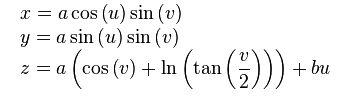
Dini’s surface has the interesting feature of having constant negative curvature that can be created by twisting a pseudosphere:


It is named after Ulisse Dini and described by the following parametric equations:


The flowers that appear in the movie "Avatar" seem to have the same shape:


13/06/2015

8. Hyperspheres

As reported in wikipedia:  http://en.wikipedia.org/wiki/Hypersphere, a hypersphere is the set of points at a constant distance from a given point called its center.

The "volume" of a hypersphere is given by:


where Γ denotes the gamma function.


The "surface area" is instead given by:
 

In three dimensions, the formula for the calculation of volume is:


As for the surface is:


For the definition of derivative, as the limit of the quotient, we have:
the surface is the derivative of the volume.

And this in each dimension:     D (Vn) = Sn-1
 

Their relationship in every dimension is remarkably simple:

    Vn / Sn-1 = R / n       e.g.  in  3  dimensions we have:  V3 / S2 = R / 3


For the calculation of hypervolumes and hypersurfaces, formulas contain:
in 2 or 3 dim. appears π,  while in 4 or 5 dim. π2,  6 or 7 dim. π3  and so on.
 

As an example for even number of dimensions, we have:


while for odd number of dimensions:


01/06/2015

6. Wallis and Pippenger Infinite Products

The Wallis product is a formula found in 1655 by John Wallis, which calculates the simple infinite product:
 

Nick Pippenger obtained an infinite product for  e: